
What AI brings to jewellery photography that traditional shoots can’t
Jewellery is among the most demanding categories in product imaging. Metals mirror their surroundings, stones refract light into rainbow flecks, and every speck of dust or micro-scratch becomes a distraction at macro scale. Traditional studio workflows solve these problems with meticulous lighting, focus stacking, and heavy retouching—work that is slow and expensive to repeat across collections, finishes, and sizes. AI jewellery product photography reimagines that process by pairing realistic rendering and intelligent editing with creative controls that were once only possible in top-tier studios.
At its core, this new approach blends product-aware AI with physically plausible light behavior. Inputs can be sketches, CAD files, or existing packshots; outputs are consistent, retail-ready images that match brand angles and lighting templates without rebuilding a studio for every SKU. Materials like 18k yellow gold, platinum, and rhodium-plated silver can be represented with specular highlights that feel true, while gemstone facets display credible fire and dispersion under neutral or lifestyle lighting. Crucially, this happens at speed—often in 2K or 4K—so collections go live on e‑commerce faster, and campaign ideas can pivot without booking another shoot.
Where AI really shines is scale and consistency. Once a hero angle and light recipe are set, rings, earrings, bracelets, and watches can be reproduced with matching reflections, shadows, and camera distances. That means fewer mismatched whites on a PDP grid, fewer off-brand backdrops on social, and fewer delays when a product manager needs three new angles for marketplace compliance. Creative teams gain agility as well: packshots on pure white, on-model close-ups for ads, and lifestyle scenes that tell a story can all be composed from a single source of truth. Platforms built specifically for high-end accessories—such as those focused on AI jewellery product photography—combine a drag-and-drop studio with smart editors so non-technical users can iterate quickly without sacrificing realism.
The result is a leaner content pipeline that supports omnichannel needs. Retailers and ateliers get launch-ready images for their storefronts, shoppable videos for social, and print-worthy renders for lookbooks—without the cost, travel, and lead times of repeated studio days. For growing brands and artisans, that efficiency is often the difference between posting once a month and showing something beautiful every week.
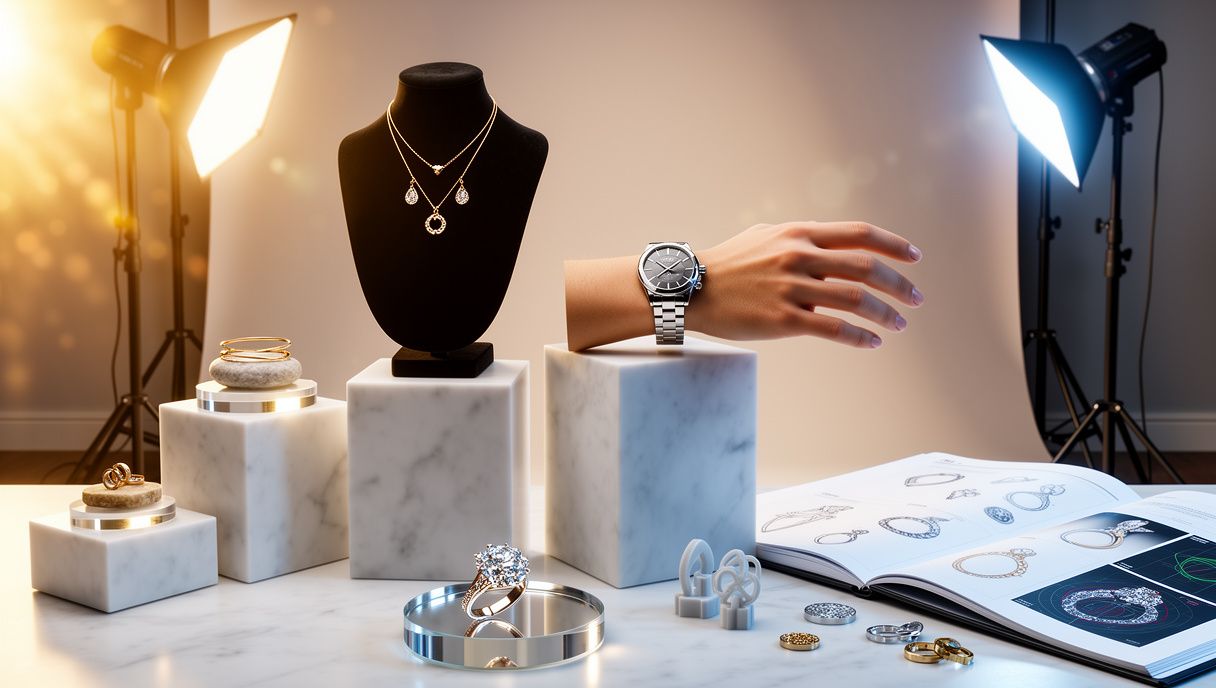
Inside an AI-first workflow: from sketch to store-ready in days
A polished AI imaging pipeline mirrors—and shortens—the classic studio path. The journey often starts with a sketch or CAD export. Geometry and proportions offer the foundation for believable micro-reflections and shadow falloff; the AI engine maps materials (metal, stone, enamel, leather) and assigns physically-based properties like roughness and index of refraction. If the input is a photo, smart segmentation isolates the product from dust, fingerprints, and colour casts, so relighting and background swaps preserve realistic contact shadows and edge glow.
Lighting is where realism emerges. Instead of dragging softboxes around a set, creators select lighting “recipes” that emulate studio rigs: top key plus kicker for crisp facet contrast; ring-light look for smooth metal sheen; lifestyle daylight with soft window gradients. Template-based angles ensure repeatability—front elevation for pendants, 45-degree hero for rings, dial-forward stance for watches—so collections feel editorially consistent. The system preserves depth of field cues and diffusion control that flatter tiny prongs and pavé settings, avoiding the plasticky look that plagues low-effort renders.
Colour accuracy is another must-have. Brands can calibrate metal tones (champagne vs. bright yellow gold), specify rhodium coolness, and lock gem hues to lab or natural references. Because the edits are parametric and product-aware, it’s simple to output 2K and 4K variants, change stones from morganite to sapphire, or explore brushed vs. mirror finishes without reshooting. Backgrounds, set pieces, and hands/wrists for on-model looks can be added with composition tools that respect reflection paths and skin realism, producing images that feel photographed, not composited.
Best practices help maintain quality at scale:
– Start with clean geometry or high-res source images; macro imperfections become more visible as resolution climbs.
– Define brand lighting presets early (e.g., 5° shadow angle, 8% ground reflection, 45° camera) to keep every PDP consistent.
– Use metal and gemstone swatch libraries so variant creation doesn’t drift in tone.
– Lock crop ratios and export profiles per channel: transparent PNGs for marketplaces, high-contrast JPEGs for PDPs, layered TIFFs for print.
– Leverage batch operations for variant families (sizes, stones, engravings) and save one-off human retouching for hero assets.
With these guardrails, an AI studio becomes a reliable production line for content—capable of launching a capsule collection, testing new creative, or localising campaigns without calling in a new crew.
Use cases and real-world scenarios that move the metrics
Jewellery and watch brands can apply AI across the entire content stack. Consider three scenarios that commonly arise as collections scale.
– E‑commerce packshots at volume. A direct-to-consumer brand needs 4–6 views per SKU on white and a transparent-background version for marketplace syndication. An AI-first workflow applies a single lighting preset across hundreds of items, enforces consistent shadows and camera height, and outputs channel-specific formats. The result is a PDP grid that looks editorially unified, which helps reduce shopper friction and supports faster site-wide updates when angles or crops change.
– Lifestyle and campaign imagery without location constraints. A growing atelier wants seasonal storytelling—warm interiors for autumn, coastal light for summer drops—without scouting or travel. AI scene design creates on-brand sets that respect jewellery scale and material behaviour, from soft window gradients to subtle table reflections. Products can be placed on surfaces, in hands, or near complementary props, all while maintaining credible specular highlights and gemstone sparkle. This opens the door to frequent creative refreshes that keep paid social and email feeling new.
– On-model visuals for ads and PDPs. Many shoppers want to see size, fit, and wearability on skin. With AI-driven on-model tools, brands generate hand, neck, or ear close-ups that match skin tones and lighting conditions selected in a scene. Consistent angles let customers compare hoop diameters or chain thicknesses at a glance, and variant swaps (yellow to white gold, diamond to emerald) happen instantly. Teams can A/B test framing and backgrounds to lift click-through and add-to-cart rates without waiting on the next studio calendar opening.
Beyond these core needs, AI supports deeper merchandising:
– Rapid variant expansion. Offer every piece in multiple metals and stones while preserving realism across facets and finishes.
– Pre-launch sells. Visualise designs from CAD for preorders and wholesale sell-in without waiting on casting and final polish.
– Market localisation. Adapt backgrounds, hand poses, and styling cues to regional tastes while keeping product rendering identical.
– Sustainability and budget control. Reduce samples, shipping, and reshoot waste; allocate spend toward hero moments where live talent or macro videography adds unique value.
Consider a hypothetical collection of 500 SKUs across rings, earrings, and necklaces. In a traditional pipeline, producing six angles plus a few lifestyle shots per piece could take months and multiple reshoots for consistency. In an AI-driven pipeline, the brand establishes a packshot preset, a lifestyle scene set per season, and a handful of on-model templates. New inventory rolls into those templates, and updates—like a clasp change or an added engraving option—propagate to every angle automatically. Merchandisers get the coverage they need, creative teams keep exploring new looks, and shoppers experience a site that feels carefully curated, not patched together.
For artisans and independent designers, the advantages compound. Translating a napkin sketch into a convincingly lit render helps validate a design language earlier. Iterations of stone shape, metal texture, or setting height appear as side-by-side visuals that inform both craftsmanship and marketing. With the same system producing photoreal e‑commerce stills, moodier campaign frames, and print-grade exports, small teams operate like much larger studios—freeing time to refine products, deepen brand storytelling, and launch more often.

Gothenburg marine engineer sailing the South Pacific on a hydrogen yacht. Jonas blogs on wave-energy converters, Polynesian navigation, and minimalist coding workflows. He brews seaweed stout for crew morale and maps coral health with DIY drones.