
Roofs in Cedar Park don’t just shelter families and businesses—they defend against a relentless Central Texas climate. From triple-digit summers to sudden spring hailstorms and wind-driven rains, local structures need purpose-built systems, materials, and installation methods that outperform generic solutions. That’s why a smart approach to Cedar Park roofing focuses on durable products, code-compliant details, and maintenance strategies that reduce lifetime costs while improving comfort and curb appeal. Whether the property is a single-family home in Buttercup Creek, a retail strip along 183, or a light industrial facility near Leander, the right roofing plan blends weather readiness with long-term value.
Local Roofing Challenges and the Best Materials for Cedar Park Properties
Sun, heat, and hail are the big three stressors that shape every roofing decision in the Cedar Park area. Prolonged UV exposure can dry out asphalt binders, accelerate shingle granule loss, and weaken seal strips. Rapid temperature swings—from cool mornings to blazing afternoons—expand and contract roofing assemblies, testing fasteners and flashings. In spring, thunderheads rolling off the Hill Country can unleash hail, while outflow boundaries produce gusts that exploit any poorly sealed ridge or eave. Add in oak leaves, cedar needles, and limestone dust that collect in valleys and gutters, and it’s clear why preventive care and high-quality components matter so much.
Material choice is the first line of defense. Architectural asphalt shingles rated Class 3 or Class 4 for impact resistance help resist hail bruising and extend service life; today’s top lines also include algae-fighting technology to curb dark streaks in our humid months. For homeowners who want elevated durability and crisp style, metal roofing—especially standing seam with concealed fasteners—delivers exceptional wind performance, minimal maintenance, and energy-saving reflectivity that can lower attic temperatures. Tile and stone-coated steel can work well on some homes too, but structural loading and fastening details must be carefully engineered for gusty conditions common to Williamson County.
Underlayments and flashings separate average roofs from truly resilient ones. Synthetic underlayments outlast felt in our heat, while self-adhered membranes in valleys and around penetrations add critical protection against wind-driven rain. Drip edge at rakes and eaves, properly kick-out flashing at walls, and metal flashings at chimneys reduce the risk of hidden leaks that stain ceilings months later. Ventilation is another locally important factor: balanced intake at soffits and exhaust at ridge lines help keep attics cooler, supporting shingle longevity and improving HVAC efficiency during peak summer load. For commercial or low-slope sections, single-ply membranes like TPO or PVC excel at reflectivity and seam integrity when properly heat-welded, detailed, and drained.
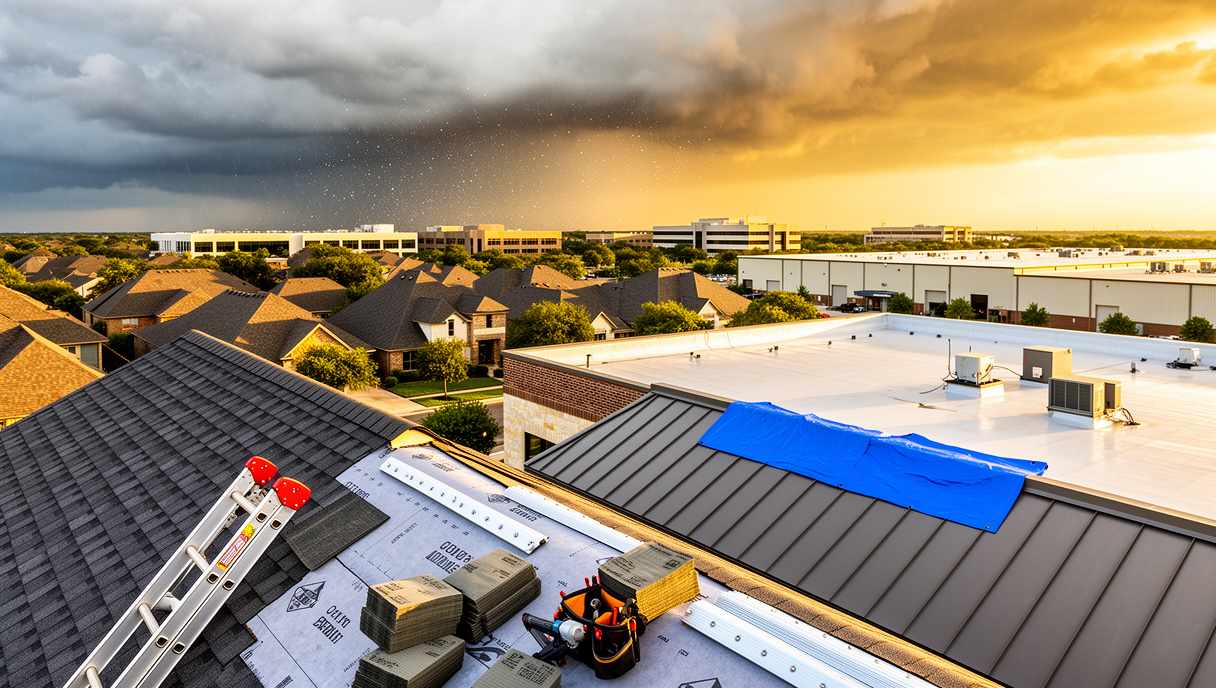
Repair, Replacement, and Preventive Care: How to Maximize Roof Life in Williamson County
Most roof problems start small—lifted shingles after a storm, a cracked pipe boot, a loose piece of flashing—and become costly only when deferred. Telltale signs include missing tabs or ridge caps, granules collecting in downspouts, interior stains around vents or skylights, and “spongy” roof decking where moisture has intruded. After high-wind or hail events common in Cedar Park, a professional roof inspection with photos helps catch damage early and document conditions for warranty or insurance purposes. If water has already found a path, immediate dry-in with tarps or temporary membranes keeps interiors protected while permanent solutions are scheduled.
When is it time to repair versus replace? Repairs make sense for localized issues on otherwise healthy systems, such as resealing flashings, replacing a few squares of shingles, or swapping out a deteriorated boot. Replacement becomes practical when the roof is nearing the end of its service life, widespread hail bruising is present, or the cost of serial repairs overtakes the value of a full system upgrade. Many Cedar Park homeowners opt for impact-rated shingles during replacement to reduce future storm vulnerability and, in some cases, to qualify for potential insurance premium considerations. Selecting trained crews and proven materials ensures the new roof is more than a cosmetic refresh—it’s a system-level improvement from deck to ridge.
Process matters as much as products. Expect a thorough evaluation, a clear scope that addresses underlayment, flashing, ventilation, and accessory upgrades, and careful site protection for landscaping and driveways. One- to two-day timelines are common for residential shingle replacements, with attentive cleanup and magnet sweeps. For property owners comparing options, a trusted local partner for Cedar park roofing can evaluate storm history, attic airflow, and neighborhood architectural standards to produce the best return on investment.
Consider a real-world scenario: after a late-spring hail cell tracked across Ranch at Brushy Creek and parts of Round Rock, a homeowner noticed granules piling at gutter outlets and minor water staining near a bathroom vent. An inspection confirmed widespread shingle bruising and cracked pipe flashings. The solution replaced the roof with Class 4 impact-resistant shingles, upgraded to synthetic underlayment and ice-and-water protection in valleys, added continuous ridge venting, and installed color-matched metal flashings. The result was a cooler attic in summer, stronger storm resilience, and an exterior refresh that fit HOA guidelines—all delivered on a tight timeline between rainy weeks. That combination of proactive planning and precise execution typifies effective storm damage recovery in Cedar Park.
Commercial and HOA Roofing Across Cedar Park, Leander, and Round Rock
Businesses and multifamily communities in and around Cedar Park face unique operational pressures: tenant comfort, uninterrupted hours, strict HOA standards, and the need to control long-term operating expenses. For retail centers, offices, and light industrial buildings, low-slope systems such as TPO, PVC, and modified bitumen are mainstays. These membranes offer excellent heat reflectivity and weldable seams—important advantages when summer temperatures push rooftop surfaces into extreme ranges. The key is design and detailing: tapered insulation to eliminate ponding, robust perimeter edge metal to prevent wind uplift, and reinforced walk pads around service routes to protect membranes during HVAC maintenance.
Preventive maintenance is the lifeblood of commercial flat roofing. A documented plan that includes semiannual inspections, debris removal, sealant touch-ups, and early repair of punctures or open seams significantly extends service life. Infrared moisture scans or electronic leak detection can identify saturated areas before they cause interior damage or jeopardize insulation performance. In the Austin Metro, where afternoon pop-up storms can soak a site with little warning, prioritized service dispatch and stocked repair materials minimize downtime and protect tenant improvements. Well-run programs pair routine care with capital planning, so owners can anticipate lifecycle costs and budget for strategic recover or replacement projects rather than rushing emergency overlays.
HOAs and multifamily communities benefit from consistent specifications that control aesthetics and performance across multiple buildings. Impact-rated shingles in approved colors, standardized ridge vents, and uniform flashing details deliver a cohesive look while reducing future variance in maintenance. Phased replacement—tackling the most weathered structures first—keeps reserves in balance and spreads logistics across seasons to avoid peak storm periods. For properties spanning Cedar Park, Leander, and Georgetown, coordination with local building departments and clear communication to residents about schedules, parking, and noise ensures smoother execution. On sites with limited staging areas or busy parking lots, careful material deliveries, safety barricades, and end-of-day cleanups maintain a professional environment throughout construction.
Finally, don’t overlook edge conditions that often drive leaks on commercial and community roofs: scuppers and downspouts undersized for torrential summer rains; failing sealant at parapet caps; loose pitch pans around electrical penetrations; and poorly aligned gutters overwhelmed by live oak and cedar debris. Addressing these details—along with robust attachment methods that meet regional wind requirements—transforms a serviceable roof into a resilient one. Whether it’s a single-tenant office near Brushy Creek Road or a mixed-use complex off Whitestone Boulevard, an integrated approach to Cedar Park roofing keeps buildings drier, cooler, and more efficient through every season Central Texas can deliver.

Gothenburg marine engineer sailing the South Pacific on a hydrogen yacht. Jonas blogs on wave-energy converters, Polynesian navigation, and minimalist coding workflows. He brews seaweed stout for crew morale and maps coral health with DIY drones.